
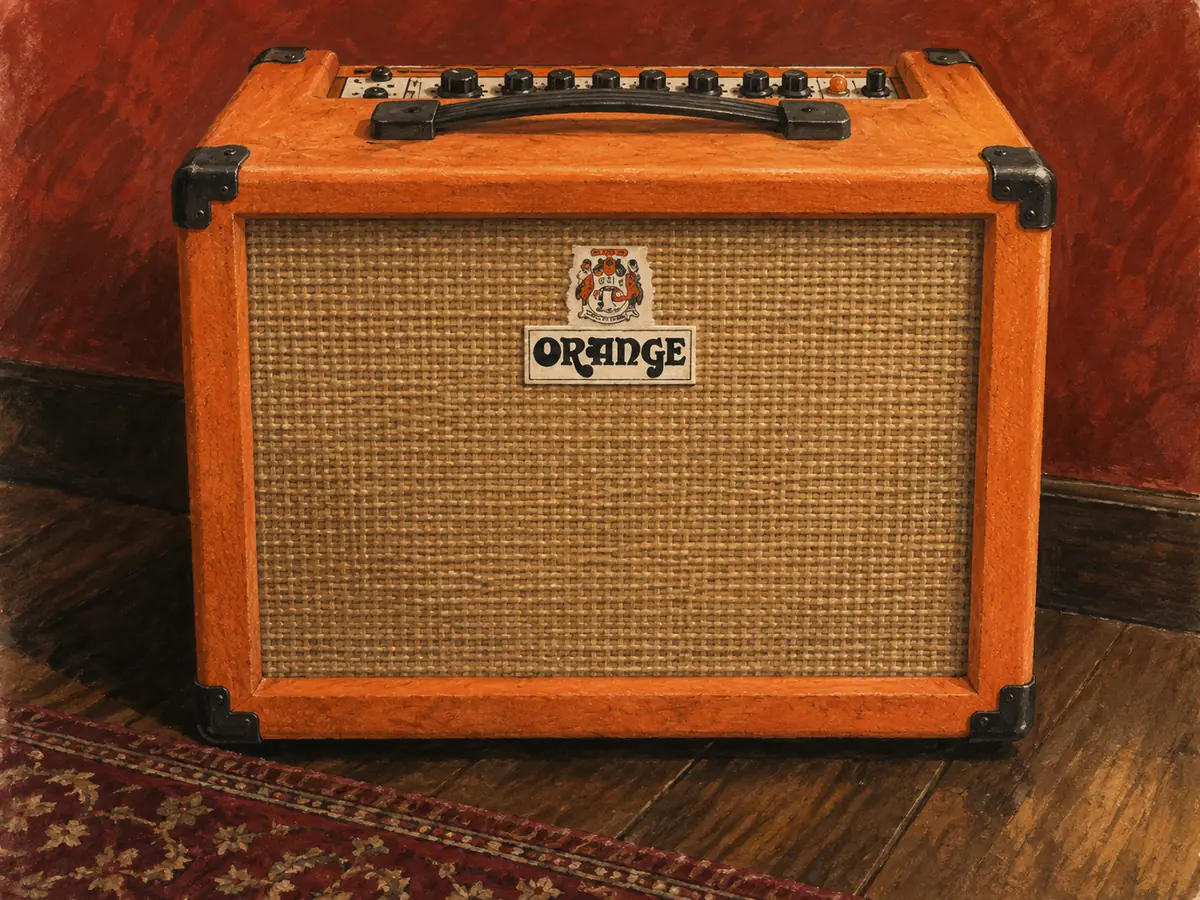
An amp should let you get from an idea to a riff with little fuss. That is the appeal of the Orange Crush 35RT guitar amp combo. There is no screen full of menus. You turn a knob, play a chord, and hear the change.
I like the balance here: enough tools to shape a sound, with few things between you and the guitar. The big question is where you plan to use it. A spare room, a quiet jam, and a loud band place quite different demands on the same box.
The Crush 35RT at a glance
| What you get | What it means |
|---|---|
| 35 watts of solid state power | No power tubes to replace |
| One 10-inch Voice of the World speaker | A compact combo you can move in one trip |
| Clean and dirty channels | Separate volume controls, with gain for the dirty side |
| Bass, middle, and treble | Shared tone controls for both channels |
| Reverb and chromatic tuner | Two useful tools built in |
| Fully buffered effects loop | A place for effects after the preamp |
| CabSim headphone output | A route for silent practice and wired recording |
| Unboxed weight of about 25 pounds | Portable, though not a tiny travel amp |
These are the core facts in Orange's current product listing. The cabinet measures about 17.3 inches wide, 15.7 inches high, and 9 inches deep. Allow more room for the cables and for air to move around it.
Who I would buy it for
The Orange Crush 35RT makes sense if you want one amp for home use and small jams. It also suits a player who likes to use a few pedals but does not want every sound to depend on them.
For roots music, I would start with the clean side. Keep the bass in check and let the pick attack come through. Add a short echo from your own delay if you want that tight slapback feel. The onboard reverb adds space, but it is not a slapback delay.
The Crush 35RT is less useful if your main goal is a wide range of stored amp sounds. It has no menu of amp models and no patch memory. You also need a separate recording device to get its audio into a computer. There is no USB audio port.
Those limits are easy to accept when all you want is a good practice amplifier. They matter more when you expect one purchase to replace a whole recording setup.
Orange Crush 35RT features: Two channels and a high gain preamp
The clean channel has its own clean volume knob. The dirty channel adds dirty gain and dirty volume. A channel selector switch lets you move between them; an optional footswitch does that job from the floor.
Why does that matter? You can set a rough level for each sound. A loud clean chord need not turn into a much louder lead line when you change channels. Match both volumes by ear at the level you will use, then check again with the rest of your gear.
The high gain preamp gives the Orange Crush 35RT its range of drive. More gain adds grit and sustain. It can also make a full chord less clear. I would turn it up a little at a time, not begin with the knob at its top.
Think of gain as how hard the sound is pushed, and volume as how loud the result is. The two interact, but they do different jobs. A high gain preamp does not mean you must play at full volume.
Does it work at low volume?
This is the point I would check most closely in a shop. Ask to hear the Crush 35RT at the level you use at home. Play soft notes, hard chords, and a few short rests. A sound that wins you over in a loud room can feel quite different beside your couch.
In this discussion of the 35RT at low volumes, an owner says they use theirs near minimum volume and like it. That is a useful report, not proof that the knob will feel right in every room. Your pickups, ears, and neighbors all play a part.
I would judge the clean and dirty channels separately. Find the softest useful clean level first. Then set low dirty gain and bring up the dirty volume with care. You want a smooth range where a small turn is easy to hear and control.
The Crush 35RT fully buffered effects loop earns its place
The fully buffered effects loop is a strong reason to choose the Crush 35RT. It sits between the preamp and the power section. In plain terms, you can put some effects after the amp makes its drive sound.
A delay pedal in front of a driven amp sends both the dry note and its repeats into the gain. That can sound thick and messy in a good way. Put the delay in the effects loop, and the repeats come after that drive stage. The result can be easier to keep clear.
The same choice matters with a looper. If you record a clean phrase in front of the amp and then switch to the dirty channel, the recorded phrase gets dirty too. A looper in the loop can keep that backing part separate from a change at the preamp. Our guide to looper pedals for guitar explains the tradeoff in more detail.
To try it, run the amp's send to the effect's input. Run the effect's output to the amp's return. Start at a low volume. Use the effect's own manual to check its level needs. An effects loop is useful routing, not a promise that every box will work at every setting.
Where should an overdrive go?
I would begin with an overdrive before the amp's input. That lets the pedal push the preamp. Start with modest drive and match the pedal's on and off levels. Our overdrive pedal guide covers that setup and the role of a mid boost.
There is no prize for using every socket. Add a pedal only when it solves a sound or control problem you can name.
The Crush 35RT headphone output and quiet recording
The headphone output includes cabinet simulation, which Orange calls CabSim. It is designed to give the direct sound the character of a miked Orange 4-by-12 cabinet. That is a different listening path from the small speaker in the room.
The Crush 35RT manual describes the headphone socket as a route to headphones, a mixer, or a recording console. Turn the volume down before you plug in. Bring it up slowly to a comfortable level.
For computer recording, you still need a suitable audio interface and the right cable. Check the input type and level on that interface. The headphone output is not a USB connection, and the aux input does not send sound to a computer.
I would treat CabSim as a useful way to catch an idea and play quietly. I would not buy the Orange Crush 35RT on the assumption that headphones will sound just like the cabinet beside you. Test that output with your own headphones if it will be your main way to listen.
The built in tuner: An integrated chromatic tuner for quick checks
An integrated chromatic tuner is a welcome touch on a practice amp. It lets you check each note without reaching for another device. Chromatic means it can read notes beyond the six open strings of standard guitar tuning.
Keep other strings quiet while you check one note. Make a small change, let the note settle, and check again. For fine setup work or silent tuning at the front of a pedalboard, see our five guitar tuner picks.
Onboard reverb without a crowded tone
The digital reverb is there to add depth. I would begin with a small amount so chords keep their edges. Turn it down when you add a long delay or several loop layers. Too many trails can fill the gaps that give a rhythm part its bounce.
The main signal path is analogue; the reverb is digital. Those facts can both be true. More useful than either label is how well you can set a sound that leaves space for what you play.
What can 35 watts do in a rehearsal room?
There is no useful yes or no answer based on watts alone. A drummer with a light touch and a small room are very different from a hard-hitting band. Clean headroom matters too: an amp may be loud enough while failing to stay as clean as you want.
My rule is to test the real job. Take the Crush 35RT to a rehearsal if the seller's return terms allow it. Set the clean sound you need, stand where you normally play, and listen for each note. Do not judge only from a foot in front of the speaker.
For a show with a PA, a microphone can change the job the combo has to do. Without that support, I would be cautious about making a 35-watt combo the sole amp for a loud room. The Voice of the World speaker still has one ten-inch cone moving air.
Buy for your usual week, not the loudest show you can imagine. If most of that week is practice, the simple controls may matter more than extra stage volume.
Set the three-band EQ around your guitar
The Orange Crush 35RT has bass, middle, and treble controls. Start with each near the middle, then change one at a time. Play the same short riff after each change. A small move can reveal more than a sweep from one end to the other.
I would reduce bass first if low chords cloud the sound. Add middle if the guitar seems lost behind other instruments. Trim treble if the pick sounds sharp. These are ways to solve a problem, not a fixed recipe for an Orange tone.
The three-band EQ is shared by both channels. Set a clean tone you like, then check the dirty side. A setting that flatters one channel may need a small compromise on the other. That is a real limit to weigh if you switch often while playing live.
The Orange Crush 35RT also has an aux input for a backing track. Connect a suitable player and start its level low. Leave enough room to hear your guitar clearly. It is one of the practice features I value more than another layer of effects.
What 35 watts does not tell you
Power, speaker size, and cabinet size describe different parts of an amp. Two amps rated at 35 watts can give a different tone in the same room. Do not compare a solid state combo with another design by the number alone.
Online videos can help you hear the range of sounds, but their microphones and playback levels shape the result. I would use videos to narrow a short list, then test the Crush 35RT with my own guitar. Its analogue circuit and direct controls make that check quick: turn, play, and listen.
Classic Orange styling, and what to check before paying
Bring the guitar you use most. Try both channels and turn each tone control through a useful range. Check the effects loop with a pedal if that feature is central to your plan. Listen through headphones as well as the speaker.
Check whether the footswitch is part of the deal. Compare the full price, including any cables you need. For a used Crush 35RT, inspect the handle, cabinet corners, sockets, and knobs. Ask about faults and the return period. A low price means less if you cannot test the amp or send it back.
The classic Orange styling has real charm: bold vinyl, a woven grille, and clear controls. Yet a scuffed cabinet can hide an amp that works well, while a spotless one can still have a noisy socket. Put function first.
Before adding the Orange Crush 35RT to a cart, check the exact item in stock. Confirm the mains voltage for your country and what is in the box. Product photos do not always show every accessory that is included. A footswitch in a shop's photo may be a separate purchase.
I would compare the delivered price and return terms, not just the price beside the product name. Allow time to check the Orange tone at home. Try the clean channel, the dirty channel, and silent practice while the return window is still open. A few days with the amp in its usual room can reveal a fit problem that a brief shop demo missed.
Give the Voice of the World speaker a fair listen
The Voice of the World speaker is part of the sound you are buying. Listen from a few feet away, then move to one side. High notes can seem sharper close to the center of the cone. The room changes what you hear too, so give the amp some space before judging its bass.
At home, place the cabinet on a firm surface with clear space around it. The Orange Crush 35RT is a mains-powered amp, not a battery unit. Plan where its power cable will run so it does not cross a walkway. Use the supplied safety guidance and leave service work to a qualified technician.
Orange Crush 35RT guitar amp combo: My verdict
The Orange Crush 35RT earns a place on a short list through its useful mix of features. Clean and dirty sounds, reverb, an integrated chromatic tuner, and an effects loop cover a lot of daily playing with little setup.
I would choose it for simple home use, pedal experiments, and jams where its clean volume is enough. I would look elsewhere for USB recording, stored sounds, or a guaranteed match for a loud drummer. Try the low-volume controls before you decide. That small check tells you more about life with this amp than another row of specs.