
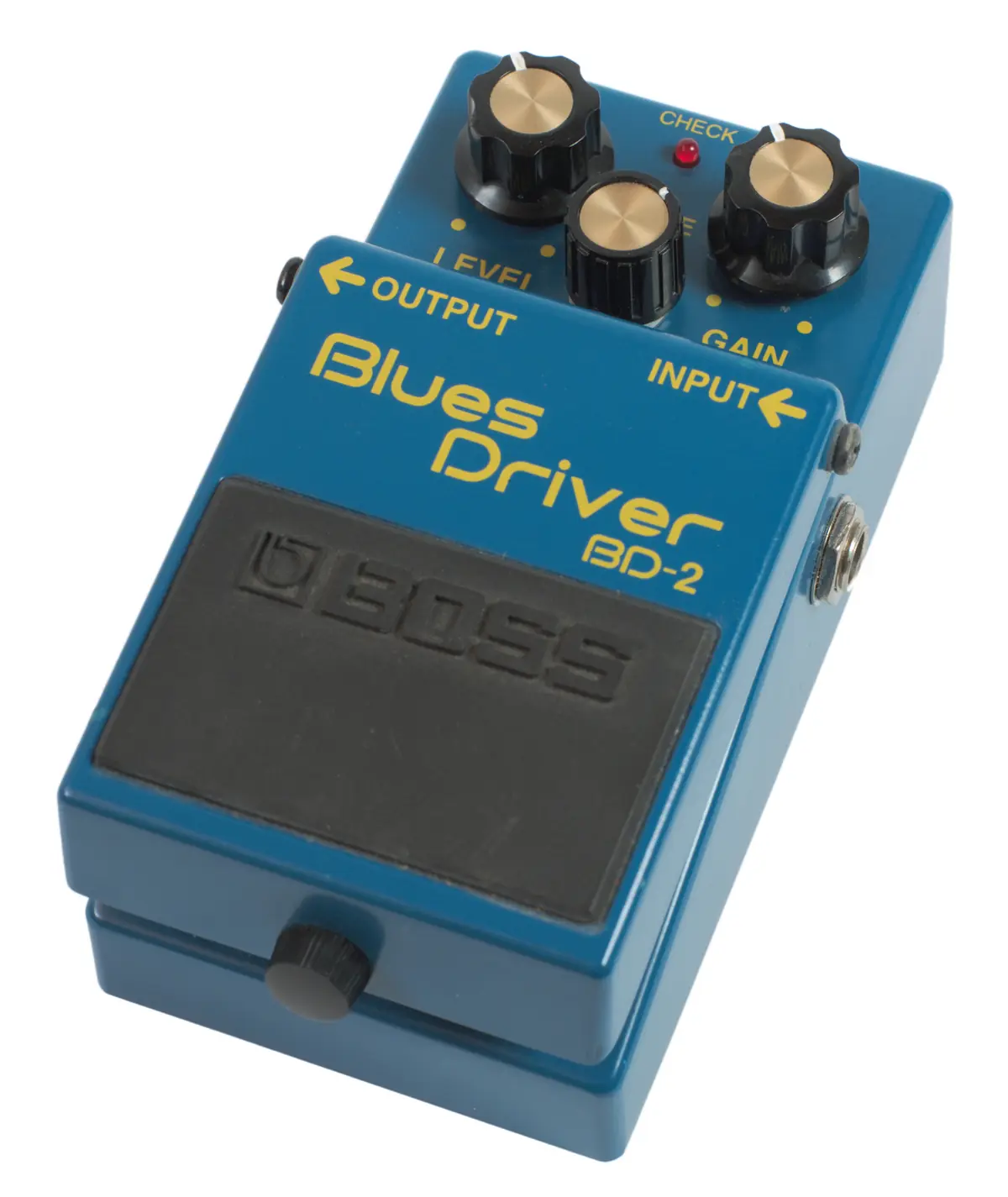
The best overdrive pedals make the guitar and amp you own more useful. One can add a little grit to a clean part. Another can push a lead through a band. The trick is to choose the job before you choose the pedal.
I would start with these five. Each has a clear role, from a first overdrive pedal to more precise tone shaping. You do not need a shelf full of overdrive pedals to find a sound that makes you play longer.
Five overdrive pedals, five clear uses
| Pedal | Why I would choose it |
|---|---|
| BOSS BD-2 Blues Driver | A broad range of overdrive for a first pedal |
| Ibanez TS9 Tube Screamer | A focused mid push to help a part stand out |
| Electro-Harmonix Soul Food | Low-gain boost with a simple treble control |
| MXR Timmy | Separate bass and treble cuts in a small box |
| Fulltone OCD v2 | A stronger overdrive voice with two gain settings |
If you are shopping for your first overdrive guitar effects pedal, the BOSS BD-2 is my default. The other overdrive pedals make more sense when you can name the sound you want to change. The same pedal can feel quite different through two amps.
1. BOSS BD-2 Blues Driver: My first pick

The BOSS BD-2 Blues Driver has Level, Tone, and Gain controls. BOSS describes a wide range, from clean boost to more aggressive overdrive. The circuit responds to picking strength and the guitar's volume control.
I like that layout for a first overdrive pedal. There is one knob for how much overdrive you add, one for the top end, and one for the output level. You can hear the role of each without first learning a set of switches.
The name can be misleading. This pedal need not stay in blues. A low-gain setting can add edge to a rhythm part; more gain can suit a rougher rock sound. The useful range depends on your pickups, your amp, and how hard you hit the strings.
Take time with the tone control
A bright guitar through a bright amp may need less treble from the pedal. Do not leave every knob at noon just because it looks neat. Start with the Tone control low, then add enough bite for the notes to speak.
In this BD-2 owner discussion, some players favor low gain and a rolled-back tone knob. Others dislike its higher-gain sound. I see that split as a reason to try it with your own rig, not proof that one group is using it wrong.
My first test would be simple. Set a clean amp sound. Add a little gain from the BD-2, then match its on and off volume. Play a soft chord and a hard one. Roll the guitar volume down and listen for how the overdrive changes.
Choose it if: You want a first overdrive pedal with a broad range and direct controls.
Pass if: You need separate bass and mid controls, or want a very specific high-gain distortion sound.
2. Ibanez TS9 Tube Screamer: Best for a mid push
The Ibanez TS9 Tube Screamer uses Drive, Tone, and Level controls. It runs from a 9-volt battery or a suitable center-negative 9-volt supply. Ibanez lists an 8 mA current draw.
The reason to choose a Tube Screamer is its mid-focused sound. It can make a guitar part easier to hear among bass and drums. It also changes the balance of the core tone, so I would not buy it if the goal is to keep every part of the clean EQ untouched.
For a direct comparison, Guitar World's TS9 and BD-2 review describes the Tube Screamer's mid emphasis and the Blues Driver's different voice. That tonal split matters more to me than which pedal has the longer list of famous users. Both are popular overdrive pedals, but they solve different problems.
Use the Tube Screamer's mid hump for a lead
An Ibanez Tube Screamer can work with its Drive control low and Level turned up. In that setup, it pushes the next gain stage while adding its own EQ. A tube amp near breakup may respond with more drive. A clean amp with lots of headroom may mainly get louder.
That is why a Tube Screamer can disappoint when copied from a demo. The player in the video may already have an overdriven tube amp. Your amp may be clean at room volume. Matching the knobs does not match the whole sound.
I would test the TS9 with full chords, not just a lead line. Listen for the low strings and for the top notes. The mid hump can help the guitar sit in a band, but it may feel too narrow when you play alone.
Choose it if: Your lead needs a focused push, or you want to shape the input to a driven amp.
Pass if: You want a flat-EQ boost or need separate control of the bass that reaches the drive stage.
3. Electro-Harmonix Soul Food: Best for low-gain boost
The Electro-Harmonix Soul Food has Volume, Drive, and Treble controls. It offers a choice of true bypass or buffered bypass. A power adapter is included in the current manufacturer's listing.
EHX describes it as a transparent overdrive. I treat that as a broad description, not a claim that it leaves the signal unchanged. Gain and EQ still affect the sound. The useful test is whether it keeps the parts of your guitar tone that you like.
I would start with the Drive knob low and use Volume to add a small lift. Bring up Treble only as needed. A low-gain setting can give a lead more presence without turning every chord into a thick block of overdrive.
The knob labeled Treble is not a full three-band EQ. You cannot use it to set bass, middle, and treble on their own. If you need to fix a deep low-end problem, start at the guitar or amp before asking this one knob to solve it.
The Soul Food is a good choice when you like your basic sound and want a gentle push. It is less suited to a player who expects one pedal to cover clean boost, heavy distortion, and fuzz. Those jobs call for different sounds and controls.
Choose it if: You want low-gain overdrive, a useful boost, and a simple way to trim the top end.
Pass if: You need heavy distortion, separate EQ bands, or several stored sounds.
4. MXR Timmy: Best for shaping the bass and treble
The MXR Timmy puts Paul Cochrane's Timmy design in a small MXR enclosure. It has Gain and Volume controls, separate Bass and Treble cuts, and a three-way Clip switch. It needs an external 9-volt supply and has no battery compartment.
I would choose it when one tone knob feels too blunt. The Bass control cuts lows before the drive stage. The Treble control cuts highs after it. That lets you change how much low end gets driven, then smooth the top of the result.
The MXR Timmy manual explains those two control points. They are worth learning before you set all four knobs at noon. These are cut controls, so their starting points differ from an EQ that boosts and cuts around a neutral middle.
How the Timmy circuit helps a boomy rig
Suppose a low chord gets loose as you turn up the gain. Cutting bass before the drive may help keep it firm. You can then trim the treble without putting all that low end back. That is the sort of clear, specific job I would buy the Timmy to do.
Try it with short chords on the low strings. Make one small bass cut, then listen again. Stop when the chord has a clear start and tail. Too much cutting can leave a rhythm part thin, especially when you play on your own.
The Timmy is often grouped with transparent overdrive pedals. I would still judge it by what it does to your sound. No label tells you how a certain pickup and amp will react. The separate cuts give you useful ways to reach the balance you want.
The Clip switch changes the clipping response. Treat each position as a fresh starting point. Match the output level after you change it, then play both a soft phrase and a hard one. A louder setting should not win by volume alone.
The left position uses asymmetrical clipping. That means the two halves of the signal are clipped differently. The middle and right positions use symmetrical clipping, with a different overdrive feel in each. MXR describes the middle as the lighter setting and the right as the heavier one. I would start in the middle, then compare the other two with the same short part.
Small overdrive pedals save space, but leave room to turn the controls. Four knobs close together can be awkward if two large plugs crowd the sides. I would check the real board layout before choosing a mini pedal just for its footprint.
Choose it if: You want low-gain overdrive with more control of bass and treble than a single tone knob gives you.
Pass if: You need battery power, large controls, or a strong mid hump as the main effect.
5. Fulltone OCD v2: Best for a stronger overdrive voice
The Fulltone OCD v2 uses Volume, Tone, and Drive controls plus an HP/LP switch. It has an internal choice of true bypass or Fulltone's Enhanced Bypass. Version 2 also adds an input stage and an output buffer to the design.
Fulltone describes MOSFET hard clipping as part of the OCD sound. That gives it a different starting point from the Tube Screamer approach. It does not mean every setting will sound harsh. Gain, EQ, guitar level, and the amp still shape the result.
I would try the Fulltone OCD when I want more overdrive from the pedal itself. Start with a clean amp and a modest Drive setting. Raise the gain slowly while playing a full chord. Stop where the extra sustain starts to hide the note you care about.
Use the HP/LP switch as a fresh starting point
The two voicings change the feel and level of the drive. Set one, match the on and off volume, then try the other. Do not keep the same Volume setting and assume the louder mode is better. Compare them at the level you will use with the band.
For a roots rhythm part, I would favor the setting that leaves space after each note. For a rock lead, I might trade some of that space for a longer tail. Neither choice requires the Drive knob to be all the way up.
The bypass choice matters most in the full pedal chain. Try the Fulltone OCD with your usual cables and other pedals. Listen with it off as well as on. A useful buffer can help a long path, but a short cable setup may need very little help.
There is no separate Bass control here. If the low strings get too thick, reduce gain first and check the amp's bass setting. If you need to trim the bass before the drive stage from one pedal, the MXR Timmy is the more direct choice on this list.
Used listings need a careful read. Fulltone has made several revisions, and sellers do not always use the version names the same way. Ask for the exact model and clear photos of its controls and label. A familiar cream box does not prove that it has the v2 features described here.
Choose it if: You want a stronger overdrive sound with two voicings and a choice of bypass modes.
Pass if: You need separate bass shaping or want a simple mid boost to push a driven amp.
What an overdrive pedal actually does
An overdrive pedal raises and shapes the guitar signal, then may clip it. Clipping changes the wave when it hits a limit. That adds harmonics, which we hear as grit, edge, and sustain.
You do not need to study a circuit to choose a good pedal. You do need to hear what happens to the attack and the space between notes. A chord can feel lively at low gain and turn into a blur with too much overdrive.
Many overdrive pedals aim for some of the feel of an overdriven tube amp. They do not require a tube amp to work. A solid-state amp can take overdrive pedals too. The final sound comes from the whole path, including the speaker and room.
Our Orange Crush 35RT review is a useful example. You can add an overdrive pedal before its input or use the amp's dirty channel on its own. Start with one source of drive, learn it, and then decide what another pedal adds.
Overdrive, distortion, and fuzz pedals
These names overlap. As a rough guide, overdrive pedals often cover a softer edge and respond to changes in touch. Distortion pedals tend to offer more clipping and sustain. Fuzz pedals can go much further, making a note sound thick, ragged, or almost broken.
There are plenty of exceptions. Overdrive pedals at full gain can have an aggressive sound. A fuzz with the guitar volume rolled down may become quite clean. Shop by what the pedal does at the setting you need, not by the word on the box.
For rockabilly rhythm, I would begin with less drive than for a long rock lead. You want to hear the short note and the gap after it. Add a short echo and the rhythm can stay clear. Too much clipping can flatten that contrast.
For hard rock, you may want more sustain and a firmer low end. An overdrive in front of an already driven amp can shape that sound. It will not always replace a dedicated distortion pedal into a clean amp.
Soft clipping and hard clipping, in plain terms
Soft clipping rounds the peaks of a signal more gradually. Hard clipping cuts them more sharply. Those shapes help explain why overdrive circuits feel different, but they do not describe every part of the final sound.
EQ before and after the clipping stage matters a lot. So do the gain range and the amount of clean signal in the path. Two overdrive pedals can use related clipping ideas and still sound quite different through the same speaker.
The Tube Screamer circuit is often used to explain soft clipping around an op amp. An op amp is a small amplifier circuit inside the pedal. You do not need a certain chip name to enjoy the result. Listen for the mid push and how it fits the song.
Do not buy by soft clipping or hard clipping alone. A simple guitar part played through your amp is a better test. Listen at equal loudness, then change one control at a time.
Overdrive pedal controls: Gain, tone, and level
The gain knob controls how hard the pedal's drive stages are pushed to create overdrive. More gain often adds grit and sustain, while reducing the gap between soft and hard notes. It can also raise hiss and make chords less clear.
The tone control changes the frequency balance. On a simple pedal, that may mostly affect the top end. A setting that suits dark humbuckers may be too sharp with bright single-coils. There is no reason to keep the knob in the same place for both.
The level or volume control sets the output. Use it to match the on and off sound first. Then decide whether you need a boost. If the pedal is much louder when on, that louder sound can seem better even when its tone is not what you want.
How the volume knob can push your amp
A clean boost aims to raise level with little added clipping in the pedal itself. If the next device runs out of headroom, though, that device can distort. A clean boost into a tube amp near its limit may create more drive, not just more volume.
Overdrive pedals can do a similar job with the gain low and the level raised. They may still change the EQ. The TS9's mid hump does not disappear just because its Drive knob is low.
Does transparent overdrive keep your original tone?
Transparent overdrive is a useful shorthand for a drive that keeps much of the starting tone. It is not a precise standard. Every circuit has limits, and each setting changes what you hear.
I would judge a transparent overdrive pedal with the guitar you know best. Play the same open chord with the pedal off and on at equal volume. Does the low end stay firm? Can you hear the top string? Does a soft note still feel soft?
Then try it with the band, if that is where you play. The sound you like alone may need a mid push to be heard. A Tube Screamer can be the right choice for that job even when a flatter overdrive sounds more natural in the bedroom.
Three overdrive sounds to try
| The job | A useful starting point |
|---|---|
| A little edge for rhythm | Low gain, matched output level, tone below noon |
| A lead that stands out | Modest gain, a small level lift, enough mids to be heard |
| Push an already driven amp | Low pedal gain, higher level, then reduce bass or gain if notes blur |
These are starting points, not exact recipes. The same clock positions can give different results on different amps. Let the guitar and the room decide where you stop.
I would begin with the guitar volume full, then roll it back and listen. Some settings clean up well; others lose too much level. Find a range that lets your picking hand do some of the work.
For a roots-style rhythm, use short chords and listen to the end of each note. If the tail gets thick and noisy, turn down gain before turning down treble. Removing all the top end can hide the pick attack you wanted to keep.
Where overdrive pedals go in the signal chain
Start with the tuner, then overdrive, then delay and reverb. That is a useful base because the drive shapes the dry note before repeats and trails are added. Our guitar tuner guide covers the front of that chain.
You can change the order for a reason. Delay before drive makes the repeats hit the drive stage too. That can create a rougher sound. It can also make a busy part hard to follow, so begin with short repeats and a low effect level.
A looper can help you compare. Record a short dry phrase with the looper before the overdrive pedal. Then change the overdrive settings while the same phrase repeats. Our looper pedal guide explains that route.
Gain staging: Stacking overdrive pedals
Stacking overdrives means running two overdrive pedals together. The first pushes the second. The later pedal has a strong say in the final EQ and the amount of clipping you hear.
Start with low gain on both. Match each pedal's volume by itself, then switch on both and listen. More drive may also mean more hiss and less note detail. If the sound turns to mush, lower the first pedal's level or gain.
Try reversing the two pedals. A Tube Screamer before a broader overdrive can push a focused band of mids into it. After that drive, the Tube Screamer shapes what has already been clipped. That difference is more useful to hear than to guess from a diagram.
I would not buy two overdrive pedals just to stack them. First find one pedal sound you like before adding other overdrive pedals. Add a second only when you need a clear extra job, such as a lead lift or a different rhythm texture.
Power and bypass checks for overdrive pedals
Read the power label. Match voltage, polarity, plug size, and current needs. Do not assume a supply is safe because it fits the socket. Use the maker's guidance for the exact model.
True bypass and buffered bypass describe what happens when the effect is off. A buffer can help drive a long cable path. True bypass routes around the active circuit. Neither guarantees a better result in every setup.
If you use vintage-style fuzz pedals, check where they want to sit. Some respond best directly after the guitar. A buffer or another active pedal in front can change that response. Test the full chain, including the drive pedals and other pedals you leave on.
For a used pedal, check the switch and every knob. Try it at low and high gain. Listen for a scratchy control, a loose jack, or a large level drop. Confirm what comes with it, then compare the full cost with a new one.
Keep a note of two settings you like before changing anything else. One can be a light overdrive sound for rhythm. The other can be a stronger lead sound. Check whether you can move between them with the guitar volume knob, or need to bend down and change the pedal. None of these five overdrive pedals gives you a separate boost channel or stored presets. That matters if the change has to happen halfway through a song.
How I would compare the best overdrive pedals
Bring your guitar and use an amp close to yours. Keep the amp sound steady as you compare these drive pedals. Play the same short part through each pedal at matched loudness. Include single notes, full chords, and a few seconds of silence.
Use a soft touch, then a hard one. Turn the guitar volume down. Check both pickups if you use them. A great pedal for a bridge-pickup lead may be too dark for a neck-pickup rhythm part.
Leave the gain knob low for the first pass. Raise it only when the part needs more sustain or edge. The best overdrive pedals should earn their place at the settings you use most, not just at the loudest point of a demo.
One more check: listen to the pedal through the clean channel and the driven channel. These are two different gain stages for it to push. A guitar pedal that adds a clear lift to a clean sound may add mostly compression to a driven tube amp. Compression narrows the gap between soft and loud notes. Turn the pedal's level down and compare again before rejecting the tone.
Match the overdrive sound to the part
As a guitar player, you can choose overdrive pedals by the part that needs help. A quiet verse, a loud chorus, and a lead break can ask for three quite different things. Decide which one the new guitar pedal must solve first.
Light overdrive for clear rhythm
For light overdrive, keep the gain low enough to hear each string in a chord. Play a short muted part, then let a chord ring. The overdrive sound should leave a clear gap between those two moves. If both become one thick wash, turn the gain down.
The BOSS Blues Driver and MXR Timmy are the first two I would compare for that job. The Blues Driver keeps the controls simple. The Timmy circuit gives you more say over the low end before it gets driven. Use the same riff and match the output volume.
A mid push for a lead
An Ibanez Tube Screamer changes the tone profile as well as the gain. Its mid hump can help a lead stand out. That is why I would try a Tube Screamer before buying more overdrive pedals just to get louder. You may need a change in EQ more than a large boost.
Listen with the band if you can. A guitar sound that feels thin on its own may leave room for bass and drums. The reverse is true too: a huge solo tone can vanish when the rest of the group starts.
More overdrive for classic rock
For classic rock or hard rock, I would compare the Fulltone OCD with the BD-2 at the gain you will use most. Check how the pedal sounds when you ease your pick attack. Does the chord regain some space, or stay dense? That response matters more than how fierce it gets at full gain.
If you need much more clipping, compare distortion pedals and higher gain pedals in the same rig. Overdrive pedals do not have to do every job. Fuzz pedals offer another kind of texture again. Choose the sound that serves the riff, then work out where it belongs in your rig.
Keep your original tone within reach
Before changing settings, play the guitar straight into the amp for a minute. Get that original tone back in your ears. Then add the guitar pedal and ask what improved. It is easy to forget the starting point after a long run of loud demos.
I would not judge popular overdrive pedals by fame alone. The Ibanez Tube Screamer, a low-gain boost, and a harder overdrive can all be useful. Their value comes from a clear job for the guitar player, not from filling every spare inch of a board.
My final choice of overdrive pedals
The BOSS BD-2 is the first pedal I would try for a broad range of overdrive. The Ibanez TS9 Tube Screamer is the focused choice when the guitar needs a mid push. The Electro-Harmonix Soul Food makes sense for low-gain boost and a simple top-end trim.
I would turn to the MXR Timmy for separate bass and treble cuts. The Fulltone OCD v2 is the one I would try for a stronger overdrive voice. Those are different jobs, so there is no need to force all five into one ranking.
Choose the pedal that improves your normal playing volume and your normal guitar part. If it makes the riff feel good without hiding the notes, you are close. You can spend the rest of the evening playing it.