
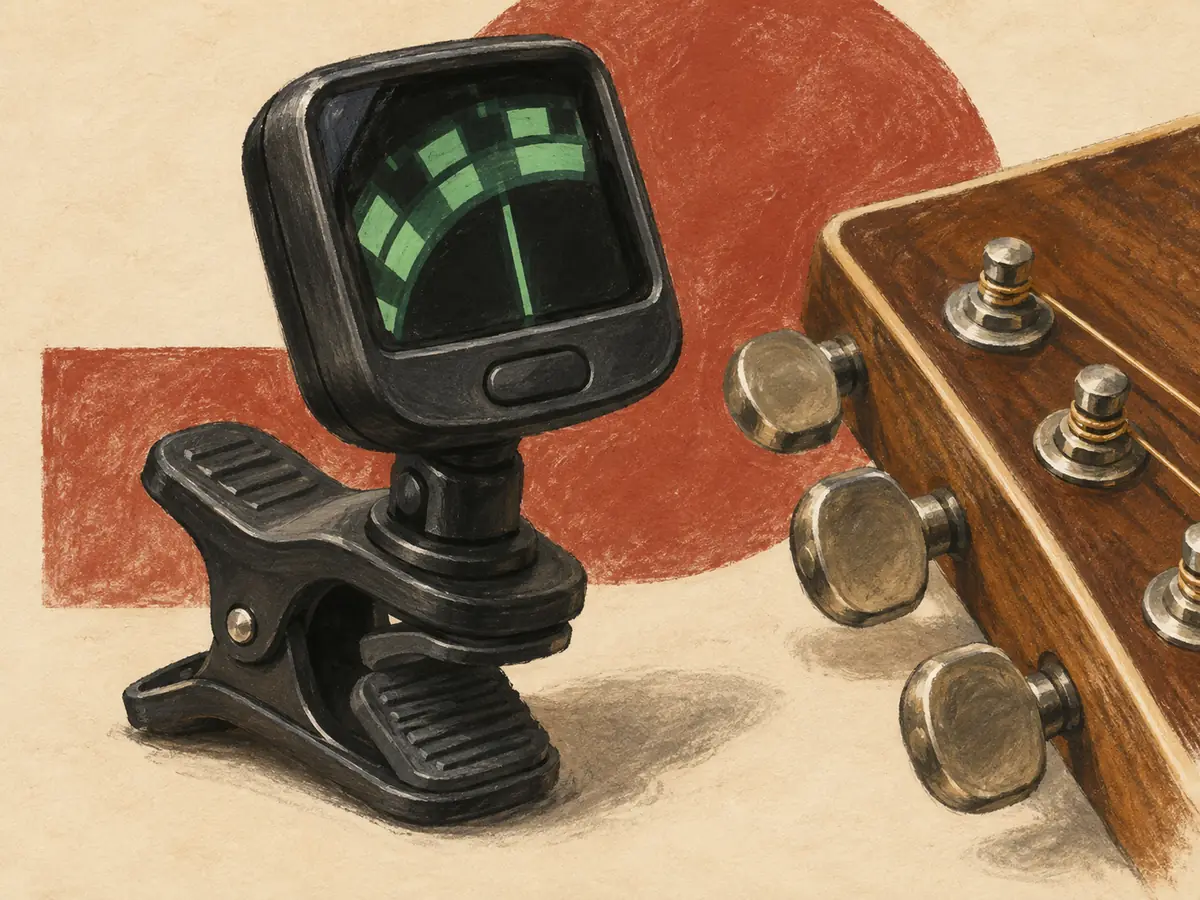
The best guitar tuners do one small job well, right when you need it. You need to read a pedal tuner at your feet. A more precise tuner is no help if its screen makes you squint. At home, a clip-on tuner may be all you need.
I would choose by where you play first, then by tuning accuracy. These five cover a busy pedalboard, a tight board, careful setup work, and a quick tune on the couch. None will fix worn strings, a binding nut, or a guitar that needs a setup.
The best guitar tuners for five different jobs
| Guitar tuner | The reason to choose it |
|---|---|
| BOSS TU-3 | A clear, simple pedal tuner with a mute and buffer |
| TC Electronic PolyTune 3 Mini | Polyphonic tuning in a small pedal |
| Korg Pitchblack X | A choice of displays and a fine strobe mode |
| Peterson StroboClip HDC | Fine strobe tuning without a cable |
| Snark ST-8 | A simple clip-on tuner for a modest setup |
For a first electric guitar rig, I lean toward the BOSS TU-3. For an acoustic guitar with no pickup, start with a clip-on. A pedal tuner needs a signal from a cable. It cannot read an unplugged guitar on its own.
1. BOSS TU-3: My first pick for a pedalboard
The BOSS TU-3 puts the main task front and center. Its 21-segment meter has a brighter mode for outdoor use. Step on the pedal and the main output mutes, so the crowd does not have to hear you tune.
BOSS lists accuracy at plus or minus one cent. The TU-3 also has chromatic, guitar, and bass modes. Its buffered bypass stays in the signal path when tuning is off. That is useful to know if you have a rig built around true bypass.
I would choose the TU-3 for its broad treadle and simple display. It gives your foot a clear target. That counts when you need to tune between songs while also watching a singer or a set list.
The main tradeoff is size. This tuner pedal takes more room than a mini pedal. It also lacks the tiny published accuracy figures of some strobe tuners. For most stage work, the more useful question is whether you can see the note and reach pitch fast.
The TU-3 has both a main output and a bypass output. Use the main output when you want silent tuning. Plan that cable route before sticking the pedal to your board.
In this thread about pedal tuners that last, players report years of use from BOSS and PolyTune pedals. Those are user reports, not a measured failure rate. I give more weight to the controls and power needs. Check the state of the unit you can buy, too.
Choose it if: You want a tuner pedal with a wide foot target, a mute, and few decisions to make.
Pass if: Every inch of board space matters, or you want strobe-level precision for detailed setup work.
2. TC Electronic PolyTune 3 Mini: Best for a tight board
The TC Electronic PolyTune 3 Mini puts several tuning modes into a narrow case. Its polyphonic mode lets you strum the strings for a quick overview. Then pick one string to check it on its own.
The PolyTune 3 Mini also lets you choose between true bypass and its built-in buffer. An always-on mode keeps the display active while you play. Side switches change those settings, so leave room to reach them when you plan your board.
I like polyphonic tuners as a quick check, not a reason to rush the final pass. Strum to find the string that needs work. Then use a single note to fine tune. That is a clear routine even when you have only a few seconds.
The small case is the benefit and the limit. A mini pedal saves space, but tightly packed patch leads can steal some of it back. The round footswitch also gives you a smaller target than a broad treadle. Try reaching it in the shoes you wear to play.
The TC Electronic PolyTune 3 Mini suits a board with the right power supply. Check the manual and the supply rating before you buy. A spare socket alone is not enough. The voltage, plug, and current must match. So must polarity, which tells you which part of the plug is positive.
Choose it if: You want a small guitar tuner pedal with a fast all-string check and a choice of bypass modes.
Pass if: You want a large foot target or have no room to reach the side controls and plugs.
3. Korg Pitchblack X: Best for a choice of displays
The Korg Pitchblack X has four display modes: Regular, Strobe, Half-strobe, and Mirror. Korg rates its strobe mode at plus or minus 0.1 cent. The stated tuning range runs from E0 to C8.
Want to try strobe tuning but keep a plain meter too? The Pitchblack X gives you both. A regular meter points you toward the middle. A strobe display uses motion: tune the string until the pattern settles.
The Korg Pitchblack X runs on a 9-volt battery or a suitable adapter. That gives it a useful place on a small rig without a shared power supply. Battery life depends on the battery and use, so carry a spare if tuning is central to the show.
I would compare the Pitchblack X and the TU-3 side by side at floor height. Do not hold each tuner six inches from your face and call that a stage test. Stand back, shift your angle, and check how quickly you can read the note.
There is little value in several tuning modes if you dislike them all. On the other hand, a display that makes sense at a glance can be worth more than a smaller case. The Korg Pitchblack X is a full pedal tuner, so include the side plugs in your space check.
Choose it if: You want fine strobe tuning, several display choices, and battery power.
Pass if: A smaller guitar tuner pedal is your main need, or one simple display already suits you.
4. Peterson StroboClip HDC: Best for fine clip-on tuning
The Peterson StroboClip HDC is a clip-on tuner with a color strobe display. Peterson states 0.1-cent accuracy. You can charge its built-in battery. It also has more than 65 Sweetened Tunings. These shift some notes by small amounts to suit a type of instrument or sound.
This is my pick if you want fine tuning without plugging in. It can move from one guitar to the next. It needs no place on the floor. That makes a fine clip-on tuner useful at home, at a bench, or in a small room.
Start with the normal equal-tempered setting. Learn what a still pattern looks like before trying Sweetened Tunings. A preset that changes some notes by a few cents should be a deliberate choice, not a mystery setting left on from last week.
A sensitive screen can show how much a note moves after the pick hits. That does not mean the guitar tuner is confused. Use a steady pluck and give the note a moment to settle. Avoid chasing every tiny flicker with a large turn of the tuning pegs.
That fine control needs care as well as cash. Do you just want a fast check before a strum? You may prefer a plain meter. You also need to keep the battery charged. Check the clip and screen angle on your own guitar's headstock before you buy.
Choose it if: You value fine tuning, play acoustic instruments, and are happy to learn a strobe display.
Pass if: You want the simplest possible clip-on tuner, or prefer replaceable batteries for travel.
5. Snark ST-8: A simple clip-on for everyday use
The Snark ST-8 Super Tight keeps the idea simple: clip it on, read the note, and turn the peg. It is a chromatic tuner, so you are not limited to the notes in standard tuning.
I would try the ST-8 for a first guitar or as a spare. It also suits a room where friends share guitars. It leaves the floor clear. You do not need a cable or a pedal power supply to use it.
There is one important fit check. The ST-8 instructions warn against use on Gibson guitars or guitars with a nitrocellulose finish. Check the finish on your instrument before you attach the clip. Soft pads do not make every clamp safe for every surface.
Do not leave a headstock tuner clipped on by habit. Put it away when you finish. A clip-on can get caught in a case or knocked as the guitar goes onto a stand. Treat the joint as a small moving part, not a carrying handle.
The Snark ST-8 is a simple choice, but that does not make it the best guitar tuner for every task. I would favor a pedal tuner for silent changes on a wired stage rig. I would choose a fine strobe tuner when I need to inspect tiny pitch shifts during setup work.
Choose it if: You want a straightforward clip-on tuner and have checked that its clamp suits your guitar's finish.
Pass if: You need a stage mute, a compatible finish cannot be confirmed, or very fine strobe tuning is your priority.
Pedal tuner or clip-on tuner?
A pedal tuner reads the signal sent down a cable. A clip-on tuner senses how the wood shakes as a string rings. Both can work well. Choose the type that fits how your guitar makes sound. Then check where you need to see the display.
For a plugged-in electric guitar, I would place a guitar tuner pedal near the start of the signal chain. It gets a clean note before drive, delay, and other pedals change it. For a purely acoustic guitar, a clip-on is often the simpler route.
A clip-on tuner can still work on an electric guitar with the volume down. It does not need the pickup output. But it cannot mute the rest of your rig, so check what the audience can hear. A pedal tuner with a mute gives you a more direct way to silence the signal.
What happens on a loud stage?
The clip reads vibration, not just sound in the air. Still, strong vibration from a stage or nearby speaker can make some readings less steady. Move the clamp to a firm spot, mute the other strings, and check again.
A pedal tuner avoids that contact problem by reading the cable signal. That is one reason it is my usual stage choice. It can have its own issues, though: a weak battery, loose lead, or active effect before it can spoil the reading.
Do you need a rackmount tuner?
A rackmount tuner makes sense when the rest of your rig already lives in a rack. A large display at eye level can be useful. For a guitar, a cable, and a small amp, rack gear adds bulk with little benefit.
Do not copy a touring rig just because it looks complete. Buy the right tuner for the setup you carry. The best guitar tuners reduce the work between songs; they do not need to become a project of their own.
Chromatic, strobe, and polyphonic tuning modes
These labels describe different things. Chromatic tells you which notes a tuner can read. Strobe describes a way to show pitch error. Polyphonic means it can assess several strings at once.
A chromatic tuner recognizes the full chromatic scale: all twelve note names, including sharps and flats. That makes chromatic mode useful for alternate tunings. A guitar-only mode may instead expect a set of string notes. Use the mode that matches your plan.
Strobe tuners show movement when a note is sharp or flat. As you get closer to pitch, that motion slows. Some digital tuners offer both chromatic and strobe modes, so you can choose the display that feels clearest.
Polyphonic tuners provide an overview after a strum. That is handy for a quick scan of six strings. Check which tunings a model supports before relying on polyphonic mode for an unusual tuning. A single-string chromatic mode is the safer place to start when the notes change.
The BOSS TU-3 calls its moving display Stream mode. Do not assume that a moving meter changes its stated accuracy to match a different strobe tuner. Compare the published figure for the model and mode you plan to use.
How much tuning accuracy do you need?
A cent is one hundredth of a semitone. A smaller stated error means the tuner can show finer pitch changes in a test. Your ear may not hear that full change in a chord.
For stage use, clear readings and silent tuning may matter most. For setup work, fine detail helps you compare the open string and fretted note. That check is called intonation. It is a good reason to look at strobe tuners.
Your hands matter too. A hard pick attack can send a note sharp for a moment. Pressing a string hard can also raise its pitch. Use a normal touch when you tune, then play a few chords with the same touch.
Do not blame the guitar tuner if open strings look right but fretted chords sound wrong. Old strings, high action, nut issues, or intonation may be involved. A tuner shows the problem; it cannot move the bridge or change the string for you.
True bypass and buffered bypass
True bypass routes the signal around a pedal's active circuit when it is off. Buffered bypass keeps a buffer in the path. A buffer helps the signal drive cable and the inputs that follow it.
Neither label is a promise of better tone in every rig. With a long cable run and several other pedals, a buffer can be useful. Some vintage-style fuzz circuits respond differently when a buffer sits before them. Check the needs of the gear you already use.
The TC Electronic PolyTune 3 Mini offers a choice of bypass modes. The standard TU-3 uses buffered bypass. Choose deliberately, then listen with your full rig. A spec sheet cannot tell you which setting you will prefer.
For a straightforward chain, start with the tuner pedal, then drive, then time-based effects. Our overdrive guide explains where the gain goes. If you use a volume pedal before the tuner, remember that heel-down volume can leave it with no signal to read.
A short routine for accurate tuning
- Set the correct reference pitch. A4 at 440 Hz is the usual starting point, unless your group uses another reference.
- Check that the chosen tuning mode matches the notes you want.
- Mute the other strings and pluck one string with a steady touch.
- Turn the tuning peg in small steps. If you pass the note, ease below it and tune upward again.
- Check all six strings once more, then play a few chords.
That last pass matters. A floating bridge can move as string tension changes. Fresh strings may also need more checks as they settle. A slow, clean pass is often faster than chasing several moving notes at once.
Tune before recording a loop. An out-of-tune chord stays in the backing track until you record it again. Our looper pedal guide starts with the simple habits that make a loop sound good.
Checks I would make in a shop
Put the pedal tuner on the floor and stand at your normal distance. Check the display from each side. Try the brightest light available. A screen that looks crisp on a desk may be hard to read beside a bright stage lamp.
For a clip-on tuner, check the clamp width and the screen angle. Make sure it grips without force. Read the finish warning before putting it on a valuable instrument. If you cannot find a safe spot, choose another style of guitar tuner.
Check the tuning range if you play low notes. Your lowest note must fall inside that range. Even so, a spec sheet cannot prove how fast a tuner will read your guitar. Test the lowest string. Use the pickup or clip spot you use when you play.
Then check power. Include an adapter or battery in the cost if it is not supplied. If a used pedal tuner has a power output, find the manual before using it to feed other pedals. That socket has limits.
Are phone tuner apps enough?
App tuners can be useful for a quiet room. A phone microphone is close at hand, and a quick check is better than no check. Background sound, mic placement, and app settings can all affect the result.
For live work, I would still carry a dedicated guitar tuner. You get a screen designed for the task and do not have to handle a phone between songs. App-based tuners also cannot mute a wired guitar rig on their own.
Keep the distinction practical. If you play on the couch, a phone app may meet the need. If you are setting up a guitar or playing a set, a proper tuner can make the job easier.
My final pick
For most pedalboards, I would buy the BOSS TU-3 and spend time learning its display. For a crowded board, the TC Electronic PolyTune 3 Mini saves space. The Korg Pitchblack X is the choice I would compare when fine strobe tuning and battery power both matter.
For a clip-on tuner, the Peterson StroboClip HDC offers fine control, while the Snark ST-8 keeps the task simple. Check the clamp and finish first. The best guitar tuners are the ones you can read, power, and use without a second thought when the next song starts.